
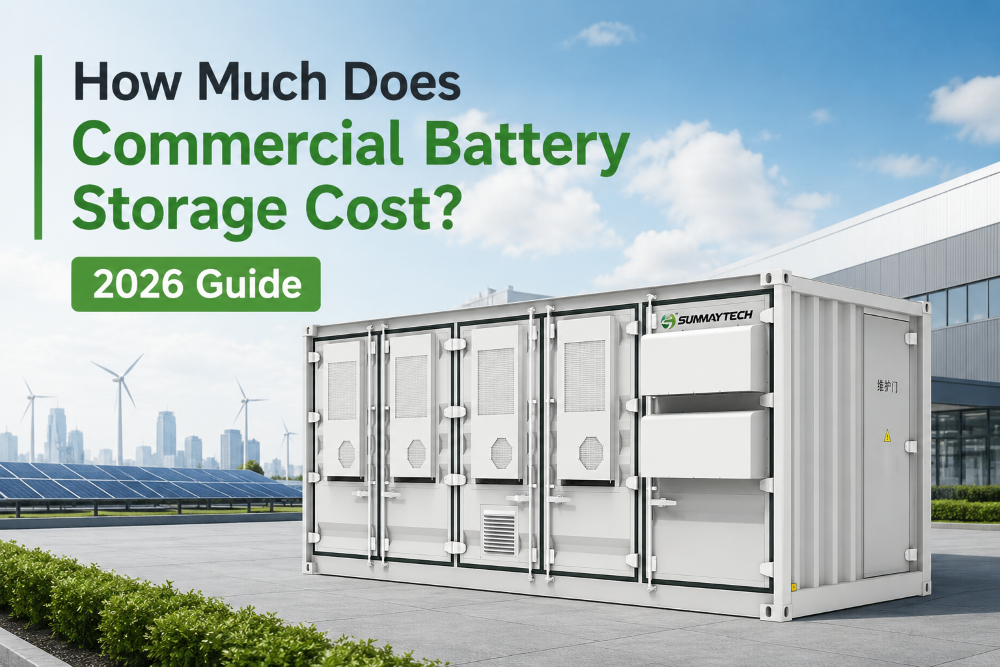
Consider a factory facing high demand charges that installs a 500 kW/1 MWh BESS for $450,000. If peak shaving, operational resilience, and renewable energy integration create $90,000 in annual value, simple payback is about five years.
Cases like this are why commercial battery storage has become an increasingly popular solution for businesses across different industries. However, one key question naturally comes to mind: how much does commercial battery storage cost?
The short answer: In 2026, commercial battery storage costs often budget near $280–$580/kWh. But that’s only the starting point. Commercial battery storage is a capital project — the price you see in a quote is only part of the total cost of ownership.
Picture shown: SW-20C-1000(2MWh)-A | 1000kW 2MWh ESS Air Cooling System
Commercial Battery Storage Costs in 2026: Typical Installed Ranges
There is no single battery storage price that applies to every facility. Capacity, output power, discharge duration, location, electrical infrastructure, permitting, and contract scope all change the final investment.
The figures below are preliminary budgeting ranges in U.S. dollars. They generally represent installed costs before financing and incentives, not firm supplier quotations.
System Type | Typical Scale | Indicative Installed Cost Range | Common Applications |
Small to Mid-Size Commercial Systems | 50–500 kWh | About $500–$1,000/kWh | Retail sites, workshops, offices, small factories, farms, and critical-load backup |
Large Containerized Commercial Systems | 100+ kWh to multi-MWh | About $180–$320/kWh (standardized projects) | Industrial plants, logistics hubs, campuses, microgrids, and solar-plus-storage |
General Commercial Battery Storage Cost Range | Mixed project sizes | About $280–$580/kWh | Early feasibility studies before site-specific engineering |
1. Small to Mid-Size Commercial Systems (50–500 kWh)
These behind-the-meter systems serve factories, office buildings, retail centers, and warehouses — primarily for demand charge reduction or critical load backup.
Typical installed cost: $500–$1,000/kWh
Why does the per-kWh cost run higher at smaller scale?
- No bulk procurement advantage. Small orders can’t access the pricing that megawatt-scale projects command.
- Fixed soft costs don’t shrink proportionally. Engineering, permitting, interconnection review, and commissioning carry similar baseline fees whether the system is 100 kWh or 500 kWh.
- High site customization. Retrofit installations in existing electrical rooms involve complex wiring, switchgear integration, and site-specific commissioning.
For a concrete example: a high-quality, certified 100 kWh turnkey system typically runs $35,000–$65,000 all-in ($350–$650/kWh). Some modular direct-supply options can bring this down to roughly $18,000–$38,000.
2. Large Containerized Commercial Systems (100 kWh to Multi-MWh)
Containerized systems are the preferred format for industrial parks, logistics hubs, large campuses, microgrids, and solar-plus-storage projects. These use standard 20-ft or 40-ft ISO container enclosures with factory-integrated battery packs, PCS, thermal management, fire suppression, and EMS.
Typical installed cost: $180–$320/kWh
The economics shift dramatically at this scale for three reasons:
- Factory pre-integration eliminates costly on-site assembly. Everything arrives tested and ready to connect.
- Bulk cell procurement from manufacturers reduces per-unit costs across the supply chain.
- Balance-of-system costs (foundations, cabling, transformers, switchgear) are spread across a much larger energy capacity, collapsing the per-kWh contribution.
A 1 MW / 2 MWh liquid-cooled containerized system may have a turnkey project cost of approximately $550,000–$750,000. When installation costs are included, the total investment for a 1 MW battery energy storage system project can increase to around $650,000–$850,000.
Commercial Battery Storage Cost Drivers
1. Application Design
What you’re using the battery for directly determines its hardware specifications and discharge rate — and therefore its cost.
Discharge duration matters. A 2-hour system (designed to release energy over two hours at full power) costs roughly 10–15% more per kWh than a 4-hour system, because fixed power-side costs like the PCS and interconnection hardware are spread over fewer kilowatt-hours.
Generally, Peak shaving applications typically require 2–4 hour configurations. Backup power applications usually require longer discharge durations, ranging from 1 hour to multiple hours. Meanwhile, frequency regulation services may be satisfied with as little as 30–60 minutes of discharge capability.
System sizing must also account for annual cell degradation of approximately 2–3%, which means a system that barely covers your peak load in Year 1 may fall short by Year 8 unless capacity is oversized at commissioning or an augmentation budget is planned.
2. System Integration Complexity
A greenfield site with spare transformer capacity and clear outdoor space is generally easier to serve than an operating factory with limited switchboard capacity, restricted access, hazardous processes, or narrow shutdown windows.
Costs also rise when the battery must coordinate with:
- Rooftop or ground-mounted solar PV
- Diesel or gas generators
- EV charging infrastructure
- Building management systems
- Industrial production controls
- Islanding and microgrid equipment
Large containerized systems benefit from factory pre-integration: battery packs, inverters, thermal control, fire suppression, and EMS arrive inside a single enclosure, pre-tested and ready to connect. This is what drives their lower per-kWh cost.
Smaller behind-the-meter retrofits require highly customized designs for existing electrical rooms, adding engineering hours and on-site labor.
3. Battery Chemistry and LCOS
LFP (lithium iron phosphate) now dominates C&I storage. It costs 20–30% less than NMC chemistry and offers exceptional thermal stability and a cycle life exceeding 6,000 cycles — making it the economically rational choice for 10-15-year project lifetimes.
LCOS considers the initial investment, financing, conversion losses, scheduled maintenance, software fees, degradation, augmentation or replacement, and the total usable energy delivered during the project’s operating life.
In addition to the battery chemistry, some important factors that can impact LCOS include:
- Usable rather than nominal capacity
- Allowable depth of discharge
- Cycle or energy-throughput limits
- Retained-capacity warranty
- Operating temperature range
- Auxiliary power consumption
- Expected degradation
- Replacement or augmentation assumptions
These factors can make a system with a higher initial price more economical over its full operating life.
4. Grid Interconnection and Electrical Upgrades
Interconnection can turn a promising equipment budget into a considerably more expensive project.
A facility may need a larger transformer, new switchgear, protection relays, revenue-grade metering, grounding modifications, a no-export controller, or utility impact studies. Fire access, equipment spacing, drainage, foundations, security barriers, and noise restrictions can also affect the site design.
These expenses are highly location-specific. They should be investigated before asking a supplier to guarantee the final price or commissioning date.
A preliminary site survey and review of the existing single-line diagram can identify major electrical constraints before detailed design begins.
5. EPC Model vs. Self-Procurement
A turnkey EPC contract bundles design, procurement, installation, commissioning, and interconnection under a single fixed price. The line-item cost appears higher than split-procurement approaches, but it delivers a single point of accountability, faster permitting, and lower integration risk.
Split procurement — buying hardware separately from different vendors and self-managing integration — can appear cheaper on paper. In practice, cross-vendor commissioning delays are common, and the hidden labor, delay costs, and warranty complexity frequently erase the hardware savings.
6. Incentives That Change the ROI Calculation
Tax credits, rebates, accelerated depreciation, demand-response payments, and capacity programs can materially improve project economics.
Eligibility varies by country, state, utility territory, ownership structure, product origin, construction date, and commissioning date. Incentive availability should therefore be verified for each project rather than assumed from a general market example.
Project owners should confirm current eligibility with qualified tax and legal advisers before including an incentive in an investment model.
How to Structure a Commercial Storage RFP
An accurate proposal begins with accurate site data. Before requesting a quote, you can prepare the following information.
- 12 months of utility bills — including itemized demand charge line items for every billing period
- 15-minute interval load data — AMI data from your utility(if available), covering at least 12 months, to reveal true load shape and variability
- Site single-line electrical diagram — confirmed by a licensed electrical engineer, including transformer kVA ratings, available capacity, and the proposed point of common coupling
- Tier 1 critical load requirements — which loads must stay on during an outage, their kW demand, peak inrush current, and the required backup duration
- Existing on-site generation assets — solar PV system capacity, inverter brand and specs, generator ratings, and interconnection details
- Target commissioning date and permitting constraints — including any applicable fire code requirements (e.g., NFPA 855 compliance in the U.S.)
How to Compare Proposals Beyond the Price Tag
1. Warranty Terms
Compare the warranty period, retained usable capacity, cycle or throughput allowance, operating-window restrictions, exclusions, and capacity-testing method.
The RFP should also clarify whether performance is measured at the battery’s DC terminals or at the system’s AC connection point. This distinction affects how conversion and auxiliary losses are treated.
2. EMS Software
Review whether the energy management system supports:
- Peak forecasting
- Tariff and time-of-use optimization
- Solar and generator coordination
- Remote monitoring and alarm management
- User access and data ownership
- Cybersecurity requirements
- Software updates
- Additional subscription fees
- Future participation in demand-response programs
An EMS should be evaluated as an operating tool, not simply as a monitoring screen.
3. O&M Service Agreement
Confirm what the operations and maintenance agreement includes. Important questions cover preventive maintenance, remote support, response times, replacement parts, technician travel, system-availability commitments, battery augmentation, and end-of-life handling.
Buyers should also identify which services are included in the original price and which will become recurring annual expenses.
4. Financial Modeling
Require bidders to use the same tariff, load data, financing assumptions, efficiency, degradation, downtime, maintenance, incentive, and electricity-price scenarios.
The analysis may compare things like:
- Simple payback
- Net present value
- Internal rate of return
- Annual cash flow
A proposal based on conservative and transparent assumptions is usually more useful than one showing the shortest payback through optimistic projections.
Sunway: A Professional Partner for Commercial Energy Storage Systems
For businesses and project developers evaluating commercial energy storage systems, Sunway Solar offers a portfolio of pre-integrated, field-proven C&I solutions designed to reduce both installation complexity and lifetime operating costs.
Headquartered in China, Sunway has delivered commercial and industrial storage projects across Europe, Latin America, Africa, Australia, and the Middle East — including a 1 MW project in Latvia, a 1 MW / 4.3 MWh project in El Salvador, a 1.2 MW project in Ireland, and a 2.15 MW project in Peru. With over 10 GW of total export capacity and approximately $50 million in annual export value, Sunway brings both manufacturing scale and global deployment experience.
Explore Sunway’s C&I Energy Storage Systems →
SWMonet-125CL | 100 kW / 261 kWh Liquid-Cooled Outdoor Cabinet
Designed for small to mid-size commercial applications, the SWMonet-125CL is an all-in-one outdoor cabinet that integrates LFP batteries (314 Ah cells), a 125 kW AC output PCS, intelligent EMS/BMS, liquid cooling, fire suppression, and power distribution — all within a single IP55-rated enclosure.
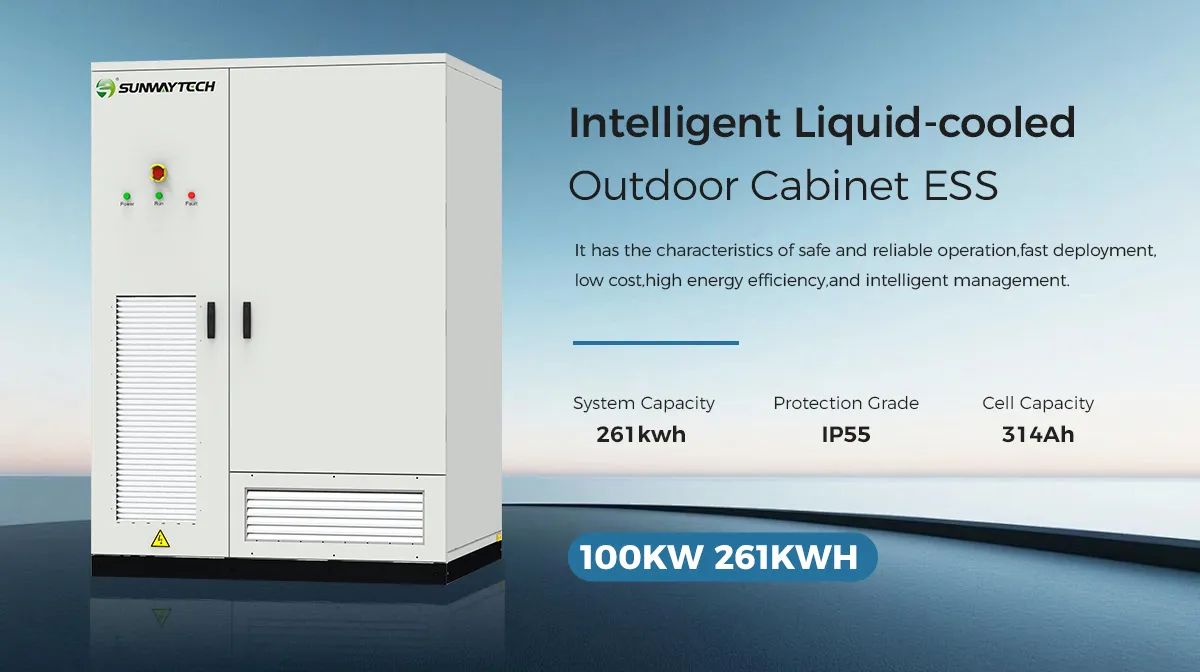
Key specifications:
- Battery capacity: 261 kWh
- Rated AC power: 125 kW
- Battery voltage range: 728 V – 936 V
- Cell type: 314 Ah LFP
- Cooling: Intelligent liquid cooling
- Operating temperature: -25°C to +60°C
- Communication: CAN / Ethernet / RS485
- Protection rating: IP55
SW-20C-1000(2MWh)-L | 1,000 kW / 2 MWh Containerized Liquid-Cooled ESS
For large commercial, industrial, and microgrid applications, this 20-ft containerized system delivers 1,000 kW of rated AC power and 2 MWh of storage in a deployment-ready package. The system ships with PCS, 314 Ah LFP batteries, intelligent thermal management, fire suppression (perfluorohexane or heptafluoropropane), and a full BMS/EMS suite integrated inside an IP54 outdoor enclosure.
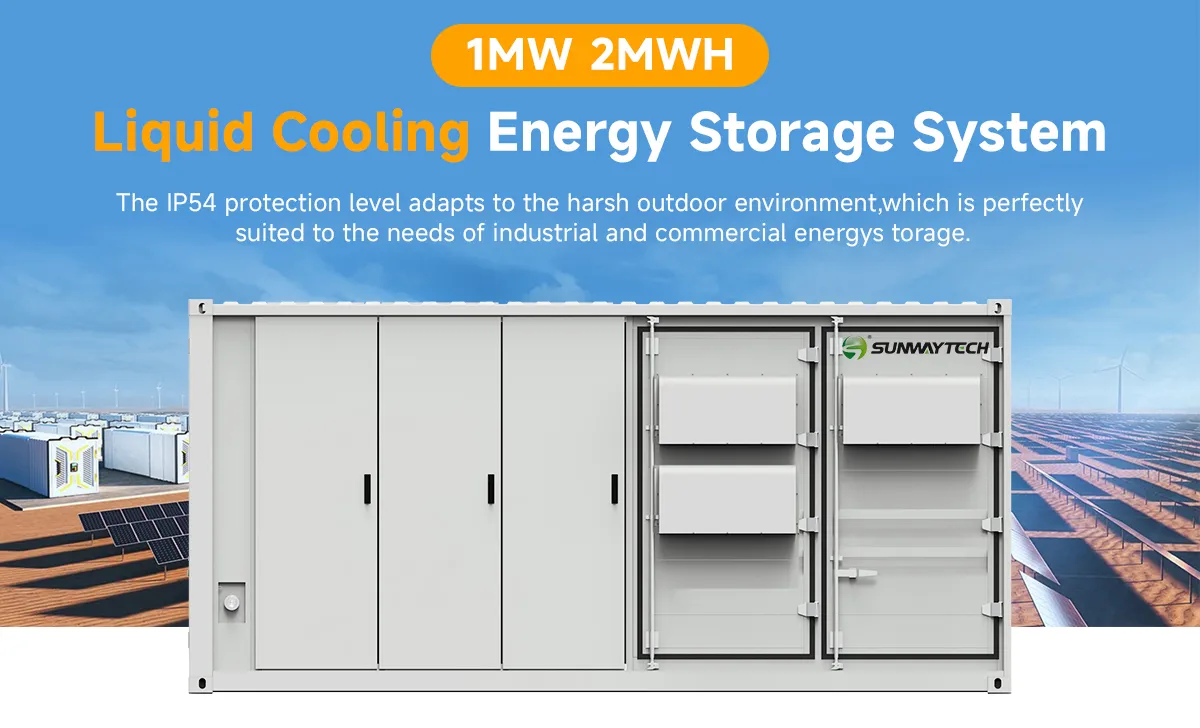
Key specifications:
- System capacity: 2 MWh
- Rated/maximum AC power: 1,000 / 1,100 kW
- DC operating range: 580–1,000 V
- Battery: 8 groups of 314 Ah LFP cells (8P×52S×5S)
- Battery compartment cooling: Liquid cooling
- Fire suppression: Integrated pipe-type system
- Operating temperature: -25°C to +60°C
- Protection rating: IP54
- Dimensions: 6,058 × 2,438 × 2,896 mm
Use cases include peak shaving, demand response, backup power, solar self-consumption, and grid ancillary services.
Sunway’s products carry international certifications including TUV, IEC, CE, ISO, INMETRO, and UL. We also maintain a European subsidiary — Sunwaytech B.V. in the Netherlands — with an overseas warehouse stocking products for rapid delivery and local after-sales support.
Final Thought
Commercial battery storage is a long-duration capital investment. Getting the sizing, chemistry, integration model, and procurement structure right from the start determines whether the project pays back in five years or ten. Sunway’s professional team works with project developers, EPC contractors, and commercial end-users at every stage — from initial system design to post-commissioning support.
Ready to get an accurate quote for your project? Contact Sunway Solar or explore the full C&I ESS product range to find the right commercial energy storage system for your application!