
How long do solar batteries last? When should you replace them with new ones?
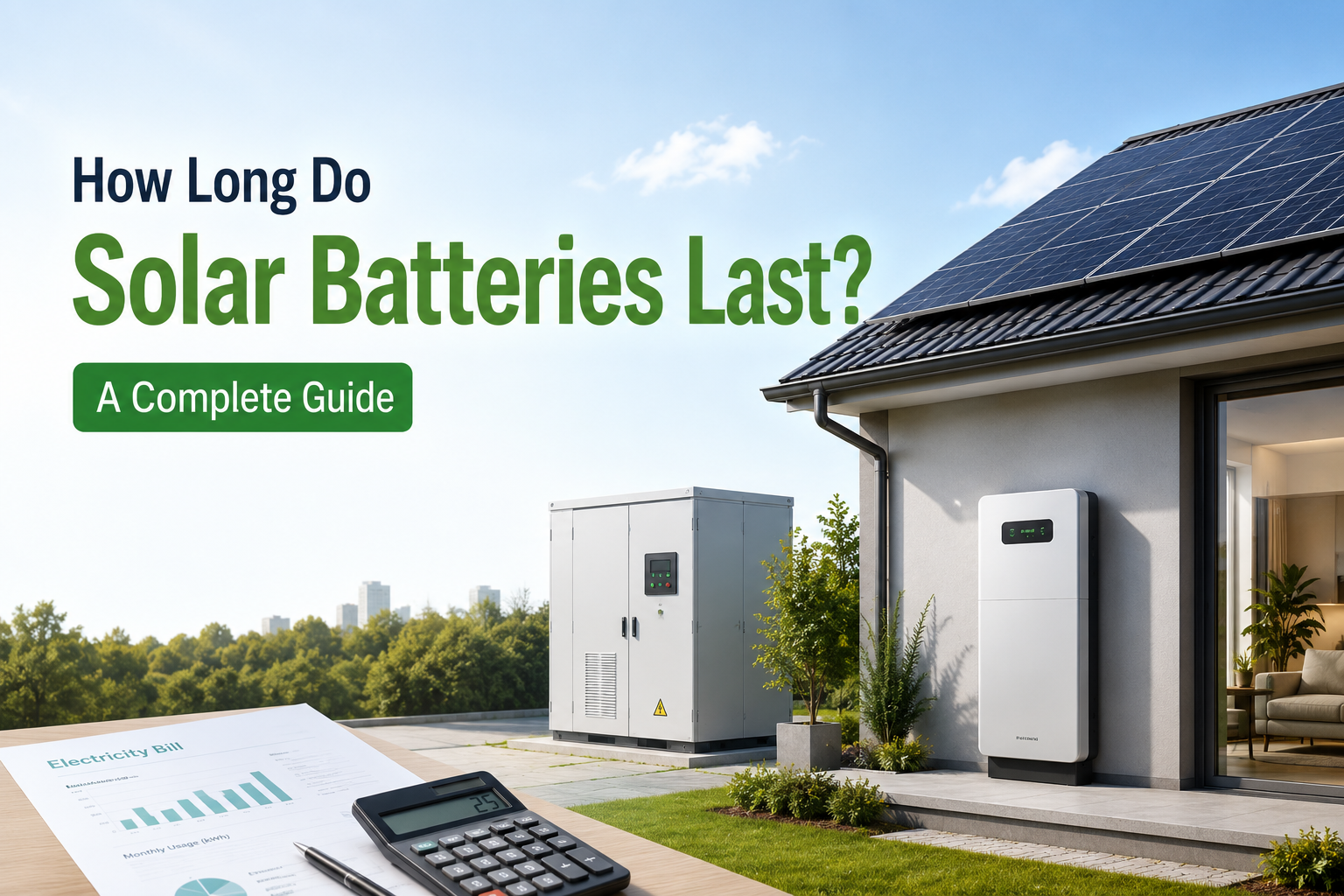
Solar batteries are long-term investments, but they usually need replacement before solar panels, which DOE-funded research by Berkeley Lab indicates can operate for about 25-35 years. Meanwhile, solar batteries are generally expected to last around 5-15 years, depending on their chemistry, design, and operating conditions.
Understanding solar battery lifespan helps homeowners budget for future replacement and choose a system that suits their needs. In this article, we will give a complete solar battery lifespan analysis guide for you!
How Long Do Solar Batteries Last by Battery Type?
Before we explain the actual solar battery lifespan, we should first know the measurements. There are normally two related measurements: calendar life and cycle life.
- Calendar life refers to how long a battery can remain in service as it ages over time. It can be affected by factors including ambient temperature and state of charge.
- Cycle life refers to how many charge-and-discharge cycles the battery can complete before reaching a specified performance threshold. Itdepends partly on depth of discharge.
For solar storage, the chemistry makes a major difference.
Battery Type | Typical Life Expectation | Key Consideration |
LFP Battery | Often around 10 years or more, depending on the product and usage | Usually designed for thousands of cycles and frequent solar-storage cycling |
Lead-Acid Battery | Often only a few years under frequent deep cycling, although calendar life can be much longer with lighter-duty or standby use | More sensitive to deep discharge and repeated cycling |
LFP Solar Batteries
Lithium iron phosphate, or LFP, is widely used in modern solar energy storage because of its long cycle life.
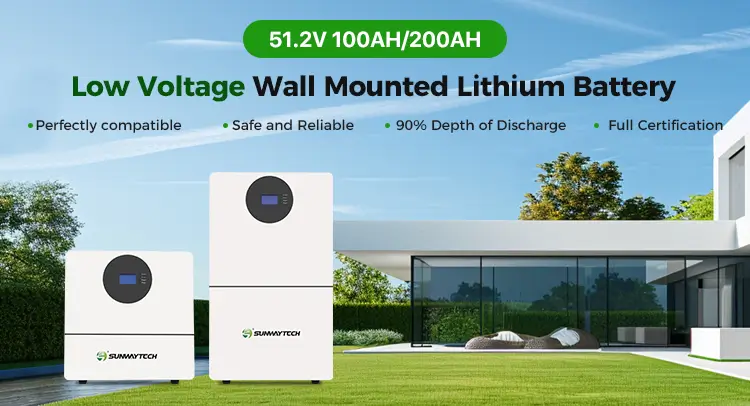
Current solar storage products illustrate the range. For example, Sunway‘s 5.12 kWh / 10.24 kWh wall-mounted LFP battery specifies 4,000+ cycles at 25°C and a design life of 10+ years, while some Sunway LFP storage products specify 6,000 or more cycles under defined operating conditions.
Note: These figures should not be treated as universal specifications for every LFP battery. Actual life depends on the manufacturer’s test conditions, usable depth of discharge, temperature, charge rate, and system control strategy.
Lead-Acid Solar Batteries
Lead-acid batteries can also be used for solar storage, especially where lower initial cost is important. However, frequent cycling can shorten their useful operating life considerably.
A 2023 U.S. Department of Energy assessment used a baseline of 1,370 cycles and a 12-year calendar life for a stationary lead-acid storage block. Importantly, the same report shows that lead-acid cycle life rises substantially when depth of discharge is reduced.
This illustrates why a battery can have a relatively long calendar life but a much shorter practical life when it is deeply cycled every day.
Also, reaching a rated cycle count does not necessarily mean that a battery suddenly stops working. Batteries gradually lose usable capacity as they age. They may continue functioning after their rated service period, but backup duration and available energy can become lower. For example, a 10 kWh battery retaining 80% of its original capacity can still store about 8 kWh, but it will provide less overnight or outage backup.
Key Factors that Affect Solar Battery Lifespan
The solar battery life expectancy printed on a specification sheet is based on defined operating conditions. Real-world conditions can produce different results.
1. Depth of Discharge
Depth of discharge (DoD) refers to how much of a battery’s stored capacity is used before it is recharged. For example, draining a battery from 100% down to 20% means a DoD of 80%.
In general, the deeper you discharge a battery on a regular basis, the faster it will degrade. Frequent deep cycling places greater mechanical and chemical stress on the electrode materials, leading to accelerated capacity loss.
Most manufacturers recommend keeping daily DoD within a moderate range—typically between 20% and 80% of total capacity—to strike a practical balance between usable energy and long-term durability.
2. Temperature
Temperature can significantly affect the lifespan of lithium-ion solar batteries. Sustained exposure to high temperatures can accelerate side reactions such as electrolyte degradation and SEI growth, increasing capacity loss over time.
Low temperatures can also affect battery performance, particularly during charging. Cold conditions can increase the risk of lithium plating on graphite anodes, especially at higher charging rates. Irreversible lithium plating can contribute to capacity loss and, in severe cases, increase the risk of internal short circuits.
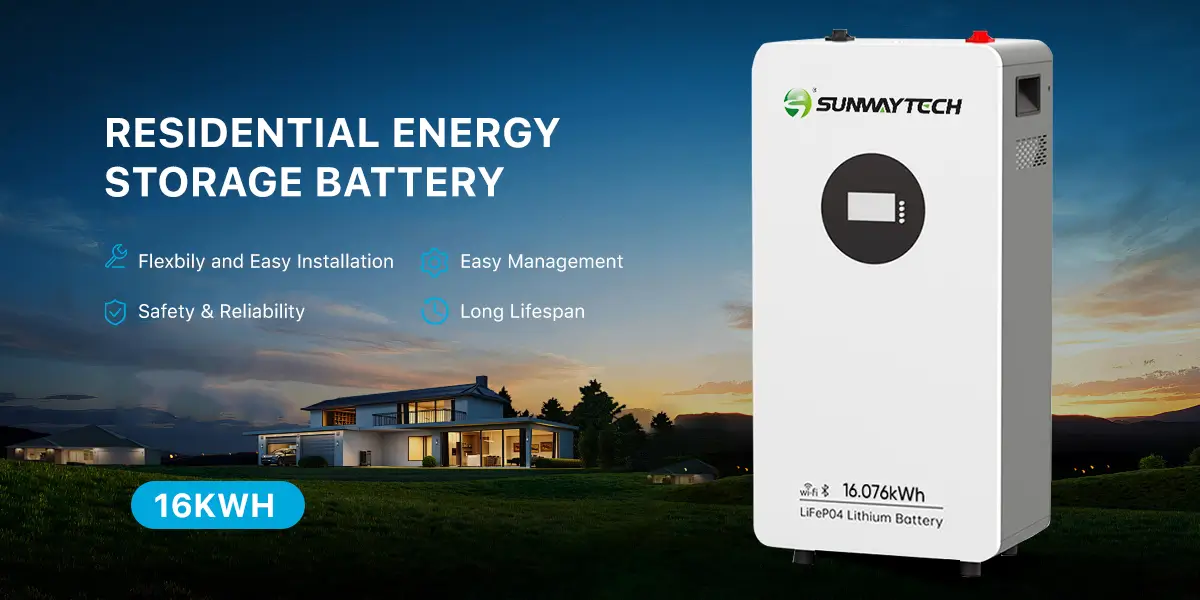
For these reasons, solar battery manufacturers generally define specific operating temperature ranges for charging and discharging. For example, the SUNWAY 16 kWh Residential Energy Storage Battery lists charging from 0°C to 55°C and discharging from -10°C to 55°C.
3. Charging Habits
Charging practices significantly influence battery aging. While solar charging is typically slow and gentle (around 0.2C to 0.5C), modern battery management systems (BMS) must still regulate charge currents to avoid stress during periods of strong sunlight.
One common mistake is unnecessarily keeping the battery at 100% state of charge for extended periods. Unlike older lead-acid batteries, lithium batteries do not benefit from being constantly topped up. Prolonged exposure to high SOC may accelerate calendar aging by promoting electrolyte degradation and other unwanted side reactions within the cell.
A smarter approach is to limit daily charging to 80–90% and reserve full charges when necessary, such as before anticipated bad weather or grid outages.
4. Battery Sizing
Battery size affects more than backup time. It can also influence how heavily the battery is cycled each day, which can affect its lifespan.
An undersized battery is forced to cycle deeply almost every day, often approaching 90–95% DoD, which rapidly consumes its cycle life. A properly sized battery, by comparison, can provide the required energy without being pushed through unnecessarily deep cycles as often, which can help it last longer.
5. Maintenance and Monitoring
Although lithium solar batteries are often marketed as “maintenance-free,” they still require regular attention to perform optimally over time. Key tasks include inspecting terminal connections for corrosion or looseness, cleaning dust from cooling vents, and ensuring that waterproof breather valves remain unblocked.
More importantly, modern smart BMS platforms enable remote monitoring of voltage, temperature, and historical DoD trends. By analyzing this data, users can detect early warning signs—such as increasing internal resistance or uneven cell balancing—and take corrective action before capacity degradation becomes severe.
Many systems also provide state-of-health (SoH) estimates, helping owners plan for eventual replacement well in advance.
How Can Homeowners Make Solar Batteries Last Longer?
Homeowners can use this practical checklist to reduce avoidable stress and support a longer solar battery life expectancy:
- Install the battery in a cool, dry, ventilated place that meets the product’s environmental and clearance requirements.
- Avoid fully discharging the battery whenever possible, while keeping enough reserve for outages or low-sun periods.
- Follow the manufacturer’s recommendations for state of charge and depth of discharge instead of applying one setting to every battery.
- Use the monitoring platform and BMS to track capacity, temperature, alarms, and unusual charging behavior.
- Choose a battery size that matches household energy use rather than forcing frequent full cycles. If you are looking for wider system-design checks, our battery storage size guidemay help you compare energy, power, backup duration, and expansion needs.
- Keep the area around the battery clean and have connections inspected regularly for looseness, corrosion, overheating, or damage.
When Does a Solar Battery Need to Be Replaced?
Homeowners should arrange a system assessment when one or more of these changes continue under similar weather and household load conditions:
- Backup time is noticeably shorter than before.
- Charging takes longer, or the battery drains faster under a similar load.
- Measured usable capacity has dropped significantly.
- BMS, inverter, or performance warnings appear frequently.
- The home depends more heavily on grid electricity even though solar production and energy use have not changed substantially.
One symptom alone does not always prove battery failure. Slow charging may also result from weak solar production, shading, temperature protection, inverter settings, or wiring problems. Swelling, leakage, smoke, unusual odor, abnormal heat, or physical damage requires prompt professional attention.
Sunway Solar Battery Systems for Long-Term Energy Storage
At Sunway, we offer solar batteries for residential, backup, and off-grid applications. Homeowners comparing long-term LFP storage can review the model-specific cycle and design-life information below.
Specification | ||
Chemistry | LFP (LiFePO₄) | LFP (LiFePO₄) |
Nominal Energy | 5.12 or 10.24 kWh | 16.076 kWh |
Cycle Life | At least 4,000 cycles at 25°C | More than 6,000 cycles at 0.5C and 80% DoD |
Design Life | More than 10 years | 10 years |
Temperature Information | Operating: 0°C to 40°C | Charging: 0°C to 55°C; Discharging: -10°C to 55°C |
Communication & Scalability | RS485/CAN; optional Bluetooth. Confirm the final configuration with Sunway | RS485/CAN; Bluetooth; up to 15 units in parallel |
Conclusion
So, how long do solar batteries last? In most residential applications, LFP solar batteries can often provide around 10 years or more of service, while lead-acid batteries generally have a shorter practical life under frequent deep cycling.
However, the actual solar battery lifespan depends on more than battery chemistry. Depth of discharge, temperature, charging habits, battery sizing, maintenance, and system management all affect how quickly capacity declines.
Sunway helps homeowners compare storage options for daily solar use, outage backup, and off-grid power. Contact Sunway with your location, household load, and required backup duration to discuss a suitable configuration!