
Battery demand is increasing across electric vehicles (EVs), solar and wind energy storage, consumer electronics, telecom backup power, robotics, and industrial equipment. Lithium-ion batteries remain the leading rechargeable battery technology because they offer high energy density, broad product availability, and a mature global manufacturing ecosystem. However, sodium-ion batteries are moving from development into commercial use as an alternative for selected applications.
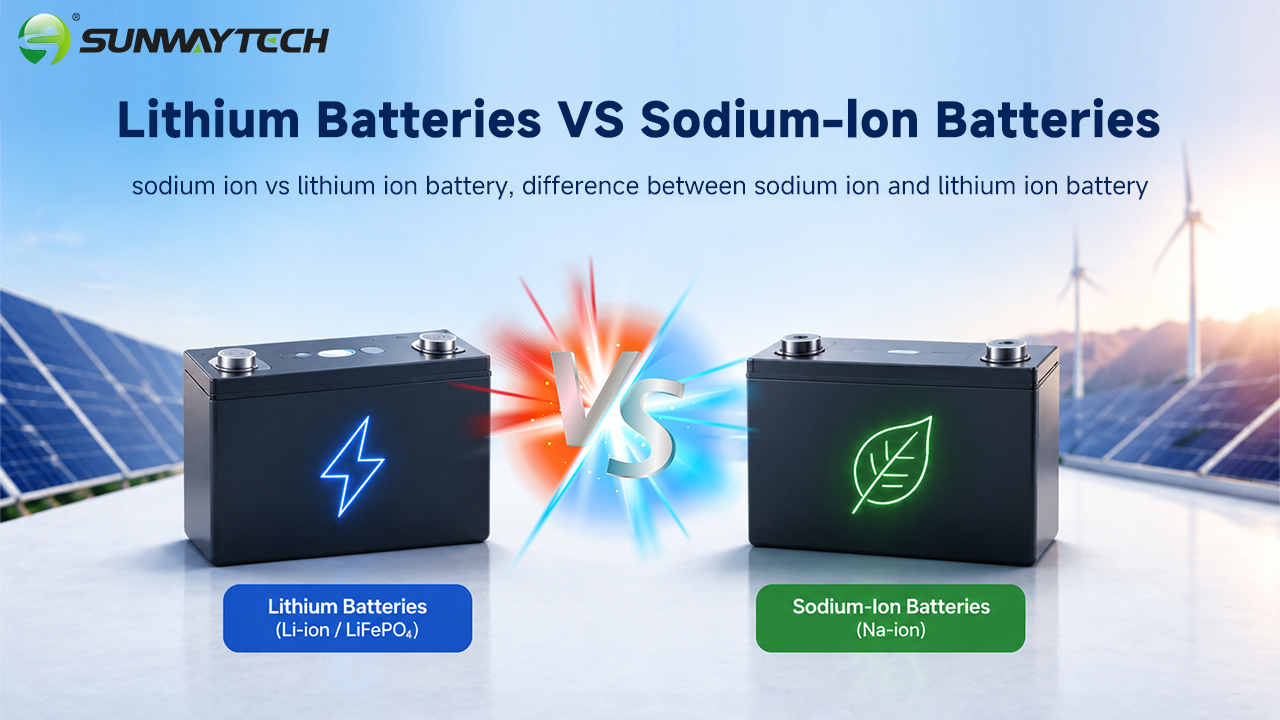
The key question in the sodium–ion battery vs lithium–ion battery comparison is not which chemistry is universally superior. The better choice depends on what the system needs most: compact size, low weight, upfront cost, low-temperature performance, supply-chain strategy, cycle life, power output, installation environment, and required certifications.
What Is a Sodium-Ion Battery?
A sodium-ion battery is a rechargeable electrochemical battery that stores and releases energy through the reversible movement of sodium ions (Na+) between two electrodes. It works on the same fundamental “rocking-chair” principle as a lithium-ion battery, but it uses sodium rather than lithium as the charge-carrying ion.
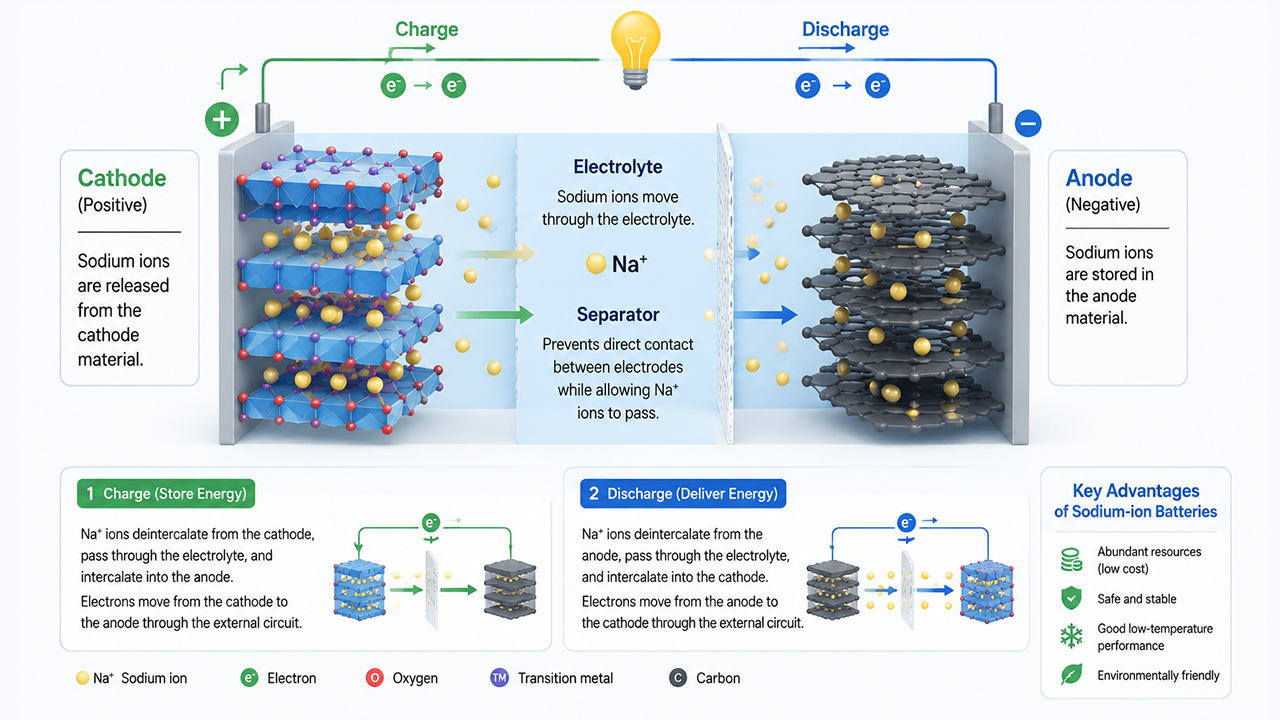
A typical sodium-ion cell includes the following parts:
Battery component | Function in a sodium-ion battery | Common material options |
Cathode | Stores and releases sodium ions during charge and discharge | Layered metal oxides, polyanion compounds, Prussian blue analogues |
Anode | Stores sodium ions during charging | Hard carbon is the most common commercial option |
Electrolyte | Allows sodium ions to move between electrodes | Usually a sodium salt dissolved in an organic liquid electrolyte |
Separator | Physically separates electrodes while allowing sodium ions to pass through | Porous polymer separator |
Current collectors | Carry electrons between electrodes and external terminals | Aluminum can often be used on both electrode sides |
BMS | Monitors voltage, current, temperature, and operating limits at pack level | Electronics, sensors, protection software and hardware |
How Sodium-Ion Batteries Work
The battery stores energy through ion movement inside the cell and electron flow through the external circuit.
Operating state | What sodium ions do | What electrons do | Result |
Charging | Sodium ions move from the cathode to the anode through the electrolyte | Electrons are supplied by the charger and move through the charging circuit | Electrical energy is stored as chemical energy |
Discharging | Sodium ions move back from the anode to the cathode | Electrons flow through the external circuit to a load | The battery delivers electricity to an inverter, appliance, or other equipment |
The larger size and higher mass of sodium ions compared with lithium ions make it more difficult to achieve very high energy density. This is why sodium-ion technology is generally more suitable for stationary storage, backup power, and other applications where a slightly larger battery footprint is acceptable.
Key Advantages of Sodium-Ion Batteries
l Abundant Resources and Cost Potential
Sodium is the sixth most abundant element in Earth’s crust, accounting for approximately 2.6% by weight. It is widely found in compounds such as sodium chloride and mineral deposits, supporting a broad raw-material base. This abundance can reduce material-supply pressure and gives sodium-ion batteries strong long-term cost-reduction potential as production scales.
l Potentially Safer and More Stable
Certain sodium-ion battery chemistries show promising thermal stability and may react less severely under abusive conditions than some lithium-ion designs. However, safety depends on the cathode, anode, electrolyte, cell construction, BMS, thermal management, manufacturing quality, and installation conditions. Product-specific safety testing remains essential.
l Good Low-Temperature Performance
Sodium-ion batteries can maintain useful discharge performance in low-temperature environments, making them relevant for outdoor energy storage, backup power, telecom sites, and cold-climate installations. The IEA reports that the latest sodium-ion cells can retain around 90% of nominal capacity at −40°C, though real performance depends on the specific battery design and operating conditions.
l Potential Environmental Benefits
Sodium-ion batteries can support a more resource-conscious battery strategy. Depending on the cell chemistry, they may reduce reliance on lithium, graphite, cobalt, and nickel, which can lower mineral-resource-scarcity impacts.
What Is a Lithium-Ion Battery?
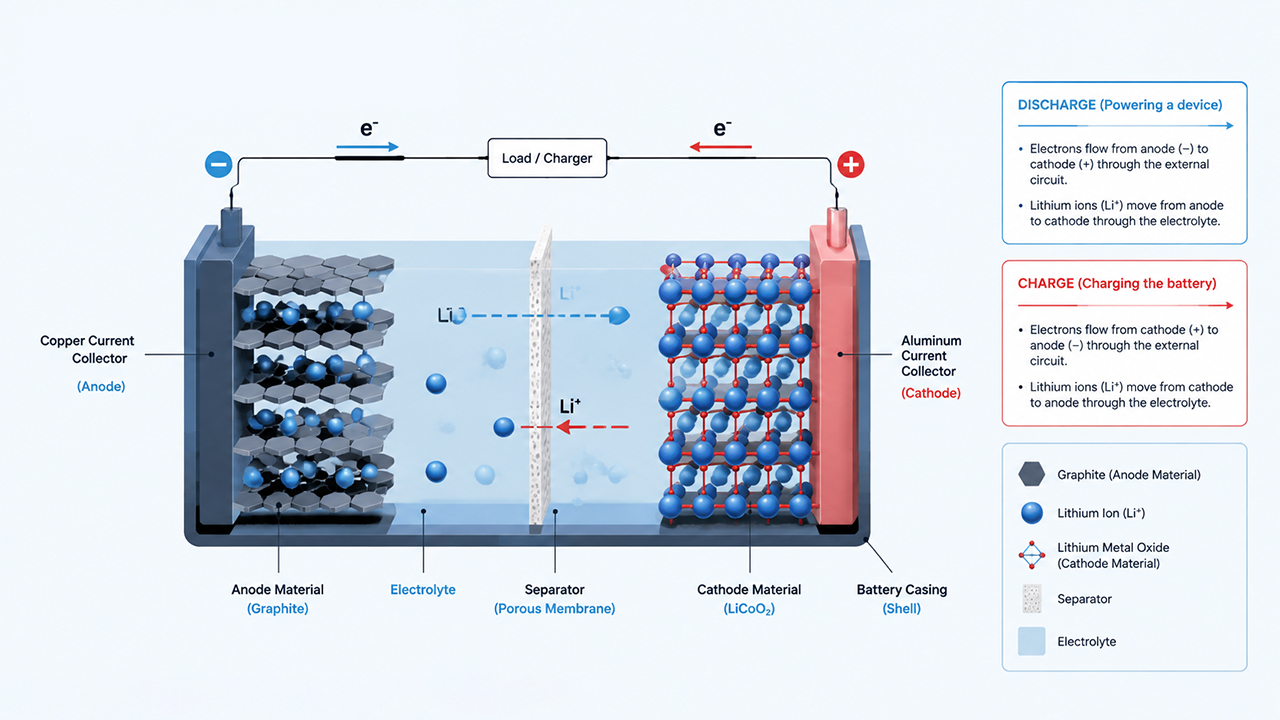
A lithium-ion battery is a rechargeable electrochemical battery that stores and releases energy through the reversible movement of lithium ions (Li +) between a cathode and an anode. It is not one single chemistry. “Lithium-ion” is a broad category that includes several cell chemistries designed for different priorities.
Lithium-ion chemistry | Cathode material | Typical strengths | Typical uses |
LFP | Lithium iron phosphate | Long cycle life, strong thermal stability, lower reliance on nickel and cobalt | Residential storage, commercial storage, buses, EVs |
NMC | Lithium nickel manganese cobalt oxide | High energy density and broad EV adoption | Passenger EVs, compact battery systems |
NCA | Lithium nickel cobalt aluminum oxide | High energy density and power potential | Selected EV and high-performance applications |
LTO | Lithium titanate-based anode system | Fast charging, high power, long service life | Industrial equipment, public transport, high-cycle applications |
LCO | Lithium cobalt oxide | High energy density at small scale | Consumer electronics such as phones and laptops |
A typical lithium-ion battery cell has the same core structure as a sodium-ion cell: cathode, anode, electrolyte, separator, current collectors, terminals, and—at the battery-pack level—a BMS. However, materials differ. A common lithium-ion anode is graphite, while the cathode may be LFP, NMC, NCA, LCO, or another lithium-containing compound.
How Lithium-Ion Batteries Work
Lithium-ion batteries work in a similar way to sodium-ion batteries, with lithium ions instead of sodium ions moving between the cathode and anode.
Operating state | What lithium ions do | What electrons do | Result |
Charging | Move from cathode to anode through the electrolyte | Flow through the charging circuit | Energy is stored in the battery |
Discharging | Move from anode back to cathode | Flow through external circuit to the load | The battery supplies electricity |
Key Advantages of Lithium-Ion Batteries
l High Energy Density
Lithium-ion cells generally store more energy per kilogram and per liter than sodium-ion cells. For example, leading LFP cells can reach about 205 Wh/kg, while the latest sodium-ion cells reach up to approximately 175 Wh/kg. This energy-density advantage enables lighter and more compact battery packs for EVs, portable equipment, and space-constrained energy storage systems.
l Strong Power and Efficiency
Lithium-ion batteries can deliver high power output with efficient charge and discharge performance. Depending on the cell chemistry and design, they can support relatively high C-rates while maintaining good round-trip efficiency. These characteristics make lithium-ion technology suitable for applications that require both sustained energy delivery and frequent power cycling.
l Mature Technology Ecosystem
Lithium-ion batteries also benefit from a well-established global manufacturing and supply chain. The ecosystem covers cell production, battery pack integration, BMS development, charging equipment, inverters, testing, logistics, and technical services. This maturity also gives battery manufacturers and system integrators access to established production processes, standards, and supporting technologies.
l Wide Range of Chemistries
Buyers can select from several established chemistries, such as LFP, NMC, NCA, and LTO. Each offers a different balance of energy density, safety characteristics, cycle life, power capability, and cost. This range allows battery designers to select a chemistry that matches the electrical, thermal, and operational requirements of a specific application.
l Low Self-Discharge
Lithium-ion batteries typically retain their charge well during storage or standby periods and do not have the significant memory effect associated with some older rechargeable battery technologies.
Sodium-Ion Battery vs Lithium-Ion Battery: A Clear Comparison Table
Comparison factor | Sodium-ion battery | Lithium-ion battery | Selection impact |
Charge-carrying ion | Sodium (Na+) | Lithium (Li+) | Sodium ions are larger and heavier, which affects energy density |
Typical anode | Hard carbon | Graphite, silicon-carbon, or LTO | Materials influence performance, cost, and supply chain |
Typical cathode | Layered oxide, polyanion, or Prussian blue analogue | LFP, NMC, NCA, LCO, LMO, and others | Lithium-ion offers a broader commercially established chemistry range |
Current collectors | Aluminum may be used at both electrodes | Typically aluminum at cathode and copper at anode | Sodium-ion may reduce copper requirements |
Cell energy density | Up to about 175 Wh/kg for leading sodium-ion cells | Up to about 205 Wh/kg for LFP and 255 Wh/kg for NMC cells | Lithium-ion remains stronger for compact, lightweight, long-range systems |
Low-temperature performance | Often stronger, especially compared with LFP | Depends on chemistry; LFP may lose more performance in cold conditions | Sodium-ion can be valuable for cold-climate stationary systems |
Supply-chain maturity | Emerging and more limited | Global and well established | Lithium-ion is usually easier to source, integrate, service, and scale today |
Cost position | Long-term cost-reduction potential | Mature pricing and substantial scale advantages | Compare real project quotations, not only raw-material assumptions |
Best fit | Stationary storage, backup power, low-voltage systems, selected mobility | EVs, consumer electronics, compact storage, industrial equipment | Select based on energy, power, space, and operating requirements |
Sodium-Ion Battery vs Lithium-Ion Battery: How to Choose the Right Battery
1. When Lithium-Ion Batteries Are Recommended
Choose lithium-ion batteries when your project needs maximum energy storage in minimum space or weight.
- Long-range EVs, electric motorcycles, drones, robotics, and automated guided vehicles.
- Consumer electronics, portable instruments, mobile medical equipment, and power tools.
- Residential or commercial storage projects with tight space constraints.
- Projects requiring a broad range of established inverter compatibility, product certifications, and service options.
- High-power systems where the selected lithium-ion chemistry is engineered for the required C-rate and peak-load profile.
2. When Sodium-Ion Batteries Are Recommended
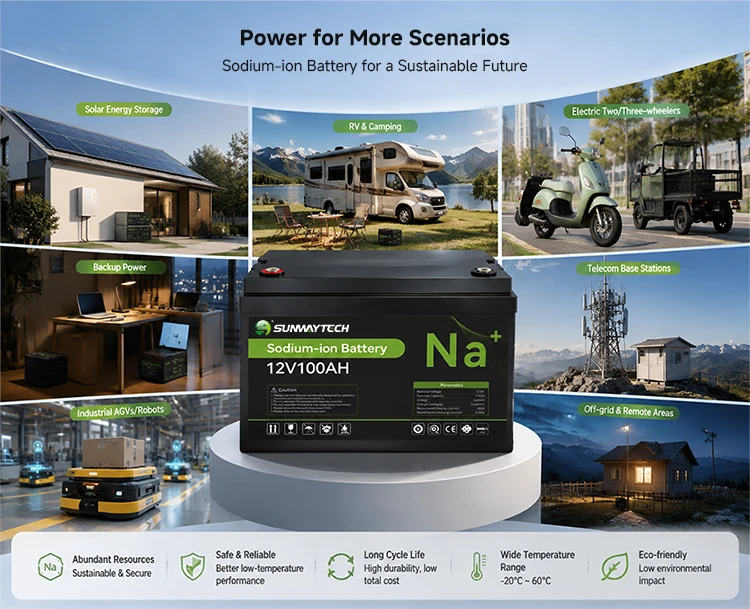
Consider sodium-ion batteries when stationary performance, cold-weather operation, low-voltage design, or supply-chain diversification is more important than maximum energy density.
- 12 V solar energy-storage systems.
- Residential and small-business backup power.
- Off-grid lighting, communications, monitoring, and auxiliary-power systems.
- Telecom backup and remote-site power applications.
- Outdoor systems in cold climates, subject to verification of the supplier’s tested charge/discharge temperature range.
- Projects where a moderately larger battery size is acceptable.
3. Four Checks Before Buying
Procurement check | What to verify |
Battery-pack specifications | Nominal voltage, Ah, kWh, usable capacity, DOD, continuous/peak current, operating temperature, dimensions, weight, IP rating, BMS, and inverter compatibility |
Purchase cost, usable lifetime kWh, expected cycle life under actual DOD, efficiency, replacement risk, maintenance, shipping, and downtime | |
Supplier readiness | Production capacity, lead time, quality controls, warranties, spare parts, technical support, and relevant project references |
UN38.3, MSDS,country-specific certifications, BMS protections, transport documentation, fire-safety requirements, and installation rules |
Sunway Battery Solutions
At Sunway, we support customers in selecting energy-storage solutions based on actual project conditions—not only battery chemistry. Our capabilities cover lithium-ion, sodium-ion batteries and energy-storage solutions, customized system design, and integrated solar-storage applications for global markets.
For example, Sunway has delivered energy-storage projects in Latvia, El Salvador, Ireland, and Peru, including a 1 MW project in Latvia, a 1 MW/4.3 MWh project in El Salvador, a 1.2 MW project in Ireland, and a 2.15 MW project in Peru. To support overseas customers, Sunwaytech B.V. serves as our European center in the Netherlands, supported by overseas warehousing and readily available battery inventory.
For customers evaluating sodium-ion energy storage, Sunway offers 12 V battery options designed for solar storage, backup power, and other low-voltage applications.
Sunway model | Rated voltage and capacity | Rated energy | Notable specifications |
12 V, 100 Ah | 1.2 kWh | ≥3,000 cycles under 25±2°C, 100% DOD, 0.5C/0.5C until capacity decays to 70%; IP65; charge from -10°C to 55°C and discharge from -30°C to 55°C; UN 38.3 and MSDS | |
12 V, 200 Ah | 2.4 kWh | ≥3,000 cycles under 25±2°C, 100% DOD, 0.5C/0.5C until capacity decays to 70%; IP65; charge from -10°C to 55°C and discharge from -30°C to 55°C; UN 38.3 and MSDS |
Conclusion
Sodium-ion and lithium-ion batteries will continue to serve different but increasingly complementary roles. Lithium-ion remains the preferred option where high energy density, small footprint, and mature product availability are decisive. Sodium-ion offers a compelling route for selected stationary, low-temperature, and low-voltage storage applications.
Contact Sunway to discuss your required voltage, capacity, power demand, operating environment, and project location. Our team can help identify a lithium-ion or sodium-ion energy-storage solution that matches your technical and commercial requirements!