
Are you tired of frequent grid outages? As utility bills climb higher and battery technology — especially lithium iron phosphate (LFP) — matures rapidly, home battery adoption is reaching an all-time peak.
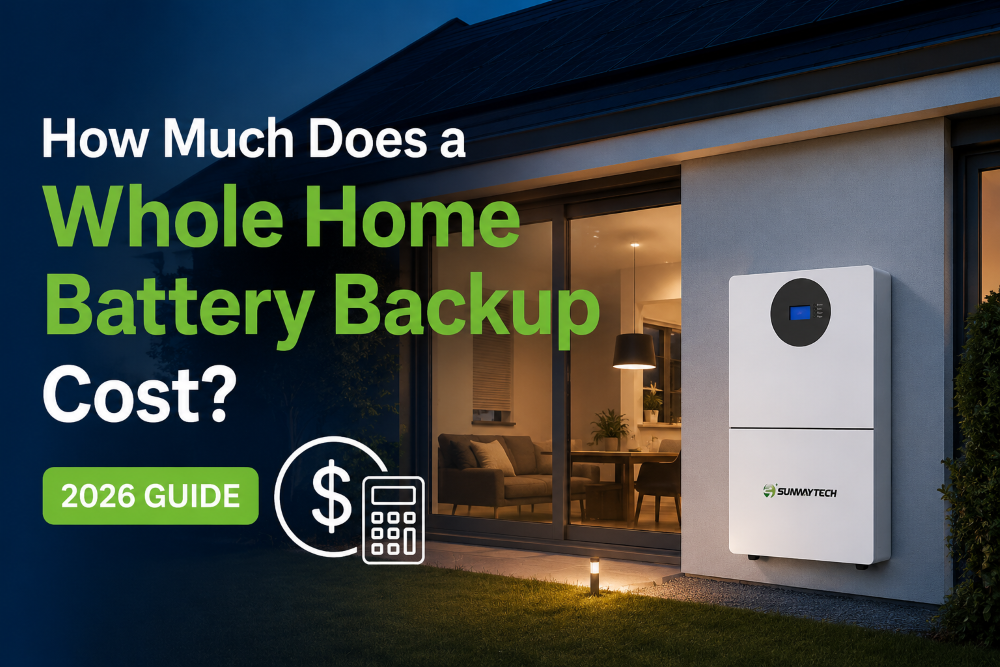
So, how much does a whole home battery backup cost in 2026? Most fully installed systems fall between $10,000 and $30,000 or more, depending on your home size, required battery capacity, and system configuration.
How Much Does a Whole Home Battery Backup Cost? Quick Reference
Use the table below as a starting point to estimate your whole house battery backup cost based on home size and energy needs.
Home / System Size | Battery Capacity | Estimated Installed Cost (Equipment + Labor) | Best For |
Small home | 5–10 kWh | $5,000 – $10,000 | Short-term essential load backup (fridge, lighting, Wi-Fi) or basic time-of-use optimization |
Average home | 10–20 kWh | $10,000 – $20,000 | Most household circuits; 8–24 hours of everyday operation |
Large / off-grid home | 30+ kWh | $30,000 – $40,000+ | Full whole-home backup including HVAC and heavy appliances; multi-day or off-grid energy independence |
Important Things You Should Know:
1. Essential Load Backup vs. Whole Home Backup — What’s the Difference?
Before you estimate your whole home battery backup cost, decide what you actually need to power.
- Essential load (partial) backup powers only your must-have appliances during an outage — refrigerator, basic lighting, router, phone chargers, or select medical devices. Because the power demand is lower, a smaller battery (5–10 kWh) is typically sufficient. Your electrician will set up a dedicated “critical load sub-panel” to isolate non-essential circuits. This is the more affordable entry point.
- Whole home backup aims to power every circuit in your house seamlessly during an outage, so your daily life is virtually uninterrupted. This requires significantly higher total battery capacity (typically 20–40 kWh or more), plus an inverter capable of high continuous output and strong surge power to start heavy loads like central air conditioning, electric water heaters, well pumps, or EV chargers.
Unsure about your capacity needs? Read our detailed guide: How Much Battery Storage Do I Need? 2026 Guide
2. Why Cost per kWh Is the Best Comparison Metric
Comparing only the sticker price of different battery systems can be misleading, since products differ widely in capacity and system complexity. The installed cost per kWh is often a more reliable benchmark.
For example, a 10 kWh system at $12,000 ($1,200/kWh) is a very different value than a 20 kWh system at $18,000 ($900/kWh).
This metric provides a clearer comparison because it spreads fixed costs—such as inverter hardware, gateway equipment, permits, and labor—across the system’s usable storage capacity. As a general rule, larger systems tend to achieve a lower cost per kWh because these fixed costs are distributed over more capacity.
Whether you’re evaluating a 10 kWh or a 16 kWh system from different brands, cost per kWh gives you a standardized, apples-to-apples comparison.
Detailed Home Battery Backup System Cost Breakdown
The total home battery backup system cost is not just the price of the battery unit itself — it’s a complete project that includes hardware, labor, electrical work, and regulatory compliance. Here’s a thorough breakdown of every cost component:
1. Battery Hardware (Capacity, Chemistry, Number)
Battery hardware typically accounts for 50% to 70% of the total system cost.
- Capacity: The larger the capacity, the higher the total price — but the unit cost per kWh usually decreases. Raw battery hardware in 2025–2026 costs approximately $400 to $1,000 per kWh,depending on the product.
- Chemistry:
LiFePO4 (LFP): The current gold standard for home storage — safer, more thermally stable, and longer-lived (typically 6,000–10,000+ cycles). Hardware cost: ~$400–$800/kWh.
NMC (Nickel Manganese Cobalt): Higher energy density in a smaller footprint, but with a shorter cycle life (~3,000–5,000 cycles) and a slightly elevated thermal runaway risk. Hardware cost: ~$500–$800/kWh.
Lead-acid: The cheapest upfront option (~$400–$600/kWh) but low efficiency and very short lifespan — not recommended for modern home energy storage.
- Number of units: A single battery unit carries a high per-unit cost when purchased alone, since it must cover the gateway, transfer switch, and other shared infrastructure. However, as more units are added, these infrastructure costs are spread out, significantly reducing the system’s average $/kWh even as total hardware cost rises, plus minimal wiring labor.
2. Hybrid Inverter or Gateway
Batteries store DC power, while home appliances run on AC — so conversion is essential.
- A standalone battery inverter typically adds $1,000 to $3,000 to your budget. Some all-in-one systems include a built-in hybrid inverter, which reduces both hardware and installation costs.
- A gateway or transfer switch — the device that safely disconnects your home from the grid during an outage — typically costs $400 to $800, though more sophisticated smart gateway solutions can reach $1,000–$3,000.
3. Installation Labor
Labor costs vary across countries and regions. For reference, installation labor typically accounts for 15% to 25% of total installation costs in Texas. Licensed electrician fees generally range from $1,500 to $5,000, depending on factors like system complexity & size and local labor rates.
4. Electrical Work
Installing a battery usually requires setting up a critical load sub-panel to move essential circuits (such as fridge, lights, Wi-Fi) onto a dedicated breaker box.
Material costs for this sub-panel typically run $200–$500, with electrician labor adding $300–$800 (plus $100–$200 per additional circuit). Overall, expect to budget $500 to $1,500 for this component.
Additional electrical adaptations — rewiring, new conduit runs, circuit reorganization — can add several hundred to several thousand dollars, depending on your home’s existing setup.
5. Permits and Inspections
Regulatory approval is mandatory to keep your system legal and fire-code compliant. Municipal permits typically cost several hundred dollars. In Texas, for example, permit costs generally range from $150 to $500, depending on the city. Additionally, utility companies may also charge interconnection fees (typically a few hundred dollars extra) to approve your grid-tied system.
6. Panel Upgrades (If Needed)
Modern battery systems can charge and discharge at high current levels, which older homes may not be able to handle.
If your home operates on a lower-amp service panel (such as those common in older homes) or if your panel has no room for additional breakers, upgrading to a higher-amp panel—typically 200 amps—will add a high but often necessary cost.
A full-service upgrade, which involves the utility company replacing the meter box, transformer, or service entrance wiring, can push costs into the many thousands of dollars or more.
Is a Whole Home Battery Backup Worth It?
A whole home battery backup cost of $10k−$30k is a serious investment. Is it worth it? The answer is yes if you value energy security, but economics depend largely on where you live.
When a whole home battery backup is worth it:
- Frequent power outages — If your area faces regular blackouts from storms, wildfires, or aging infrastructure, a battery pays for itself in reliability.
- Medical necessity — Households relying on oxygen machines, refrigerated medication, or powered medical devices need guaranteed uptime.
- Solar panel pairing + TOU rates — Storing solar energy and discharging during peak-rate hours can meaningfully cut electricity bills.
- Strong local incentives — States like California and New York offer rebates that can shrink payback periods to 5–8 years.
- Long-term homeowners focused on sustainability — Reduces grid dependence and carbon footprint over time.
When it might not be worth it:
- Stable urban grid — Fewer than 1–2 outages per year makes the financial case difficult to justify.
- No solar or flat-rate electricity — Without time-of-use savings, payback can stretch to 10–15+ years.
- Short-term or rental properties — Upfront costs rarely recoup within a typical move-out window.
- No local rebates or incentives — Full out-of-pocket cost with no programs to offset it changes the math significantly.
For some further information, read our guide: Is a Hybrid Solar System for Home Worth It?
Sunway Offers Reliable Whole House Battery Backup System Products
Sunway Solar is a professional solar energy manufacturer and storage system supplier, offering a range of high-safety, long-life LFP battery solutions designed for homes of all sizes. Here are three core products covering the full spectrum of residential storage needs:
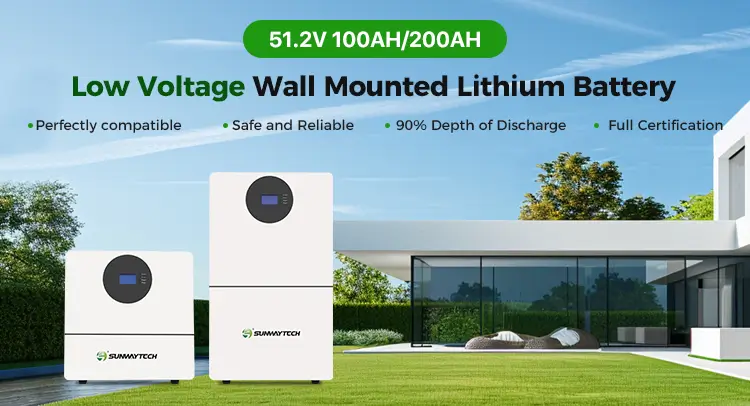
1. 10 kWh Wall-Mounted House Battery Backup System
Ideal for small to average-sized homes seeking essential load protection or solar self-consumption optimization.
Specification | Details |
Capacity Options | 5.12 kWh (100Ah) / 10.24 kWh (200Ah) |
Rated Voltage | 51.2V |
Cell Type | LiFePO4 (LFP) |
Cycle Life | ≥4,000 cycles @ 25°C |
Design Lifespan | 10+ years |
Protection Rating | IP65 |
Communication | RS485, CAN (Bluetooth optional) |
Installation | Wall-mounted; compatible with most hybrid and off-grid inverters |
This compact, wall-mounted unit is built with a fully integrated BMS and a physical circuit breaker, with over 20% electrical design redundancy for enhanced safety. Its IP65 rating makes it equally suitable for garage and outdoor installations, while broad inverter compatibility means it integrates quickly into most existing or new solar setups.
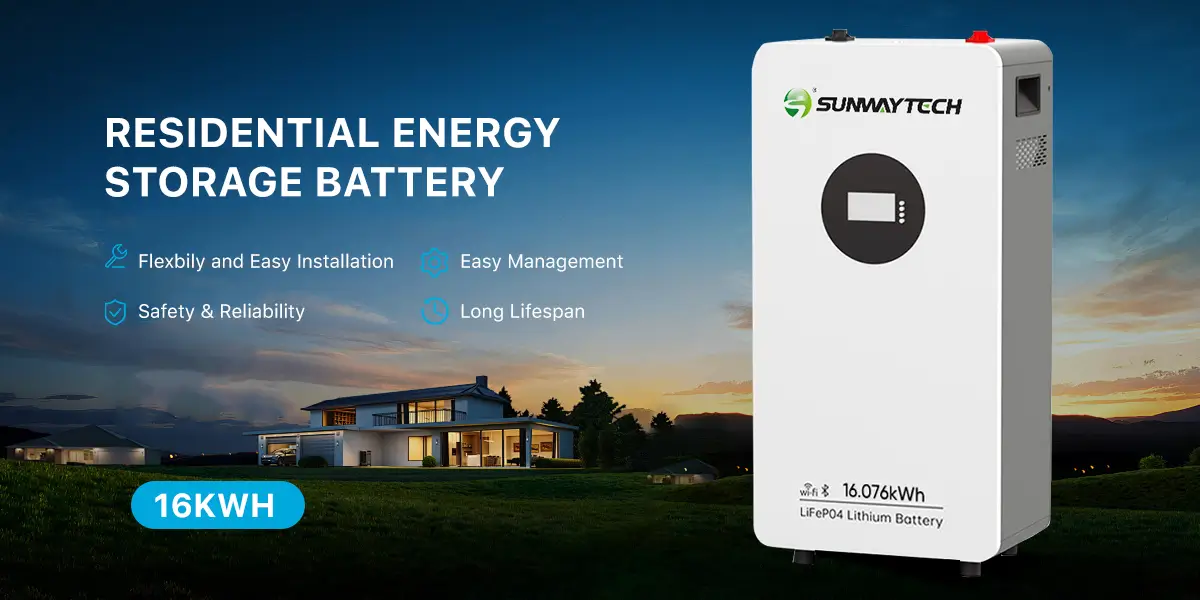
2. 16 kWh Home Battery Backup System
A high-capacity floor-standing solution for average to large homes, capable of handling demanding appliances.
Specification | Details |
Model | SW51B314TW2 |
Rated Capacity | 314Ah / 16.07 kWh |
Rated Voltage | 51.2V |
Max Discharge Power | 8,000W |
Max Continuous Current | 150A |
Cycle Life | ≥6,000 cycles @ 80% DoD |
Scalability | Up to 15 units in parallel |
Certifications | CE, EMC, UN38.3, MSDS |
Installation | Floor-mounted |
With a maximum discharge power of 8,000W and a rated capacity of 16.07 kWh, this system can handle high-draw appliances comfortably. Its modular, parallel-expansion design — supporting up to 15 units — means you can scale capacity as your energy needs grow, without replacing the system. The Sunway intelligent BMS ensures stable, protected operation throughout its lifecycle.
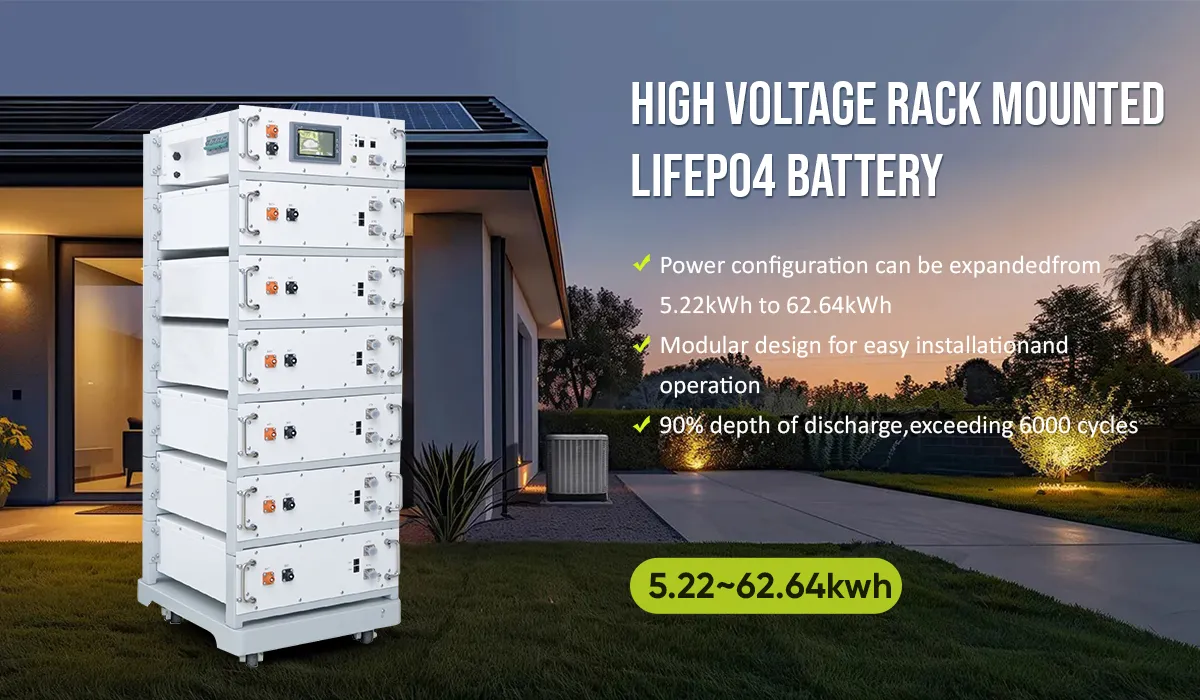
3. 62 kWh Rack-Mounted House Battery Backup System
The flagship choice for large homes, off-grid setups, and commercial or agricultural applications requiring serious, scalable energy storage.
Specification | Details |
Model | HRH-5200 |
Module Capacity | 5.22 kWh per module |
Total Scalable Capacity | 5.22 kWh – 62.64 kWh |
Cell Type | LiFePO4 (LFP) |
Cycle Life | ≥6,000 cycles @ 90% DoD, 0.5C, 25°C |
Communication | RS485 / CAN |
Operating Temperature | 0–50°C |
Fire Safety | Integrated thermal aerosol suppression system |
Design | Plug-and-play modular rack-mounted |
The HRH-5200 is engineered for scenarios where large capacity and long-duration reliability are non-negotiable. Its plug-and-play modular architecture makes installation and future expansion straightforward.
For maximum fire safety, the system includes an integrated high-temperature-triggered passive thermal aerosol fire suppression system — a level of built-in protection rarely seen in residential-grade storage products.
Compatible with mainstream inverter brands via RS485/CAN, it fits seamlessly into both new and existing solar energy systems.
Final Thoughts
Whether you’re a homeowner looking to stay powered through the next outage, a small business owner aiming to cut peak demand charges, or a solar project developer sourcing reliable storage for your next installation, understanding the true whole house battery backup cost — from hardware to permits — is the foundation for making a smart investment.
Sunway Solar’s battery lineup covers every scale of residential and commercial need, backed by LFP chemistry, robust BMS protection, and international certifications. Explore Sunway’s full range of energy storage products at sunwaypv.com, or reach out to our team directly to discuss a solution tailored to your specific project!
Relevant information:
- https://www.currenthome.com/blog/decoding-solar-battery-backup-cost/
- https://ecowised.com/whole-house-battery-backup-cost-2026-guide-prices-installation-what-to-expect/
- https://solartechonline.com/blog/lithium-home-storage-battery-cost-guide-2025/
- https://nrgcleanpower.com/learning-center/solar-battery-cost/
- https://aesrenew.com/knowledge-base/what-is-the-labor-services-cost-of-installing-a-home-solar-battery/
- https://www.eos-e.com/blog/home-battery-backup-cost-texas